
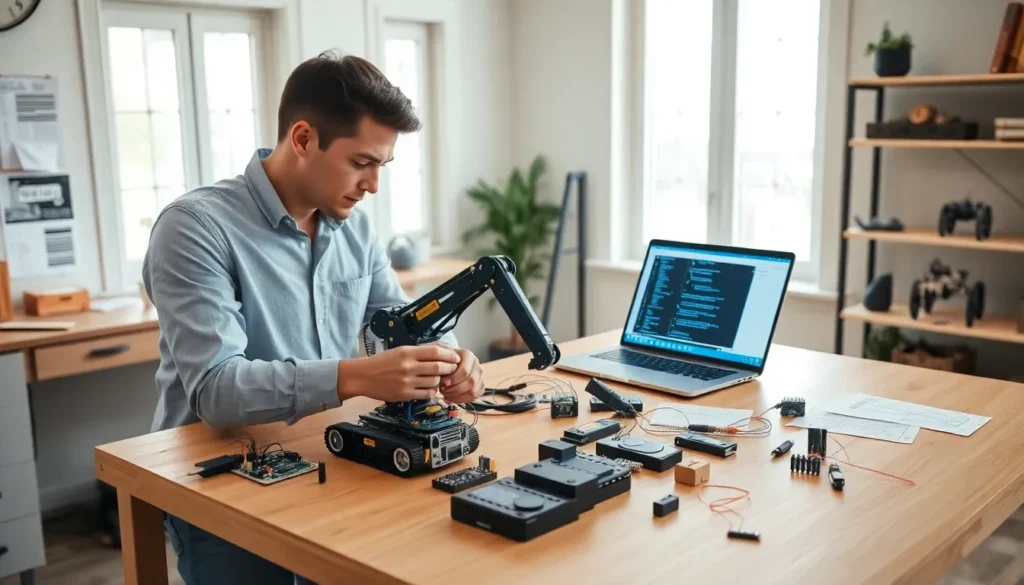

Robotics ideas spark creativity and problem-solving skills at every experience level. Whether someone is building their first line-following bot or designing an autonomous drone, robotics offers a hands-on way to learn programming, engineering, and electronics. The field has grown more accessible than ever. Affordable components, open-source platforms, and online tutorials make it possible to start building from a kitchen table. This guide covers robotics ideas for beginners, intermediate builders, and advanced enthusiasts. It also explores practical home applications that turn hobby projects into useful tools.
Table of Contents
ToggleKey Takeaways
- Robotics ideas span all skill levels, from beginner line-following bots ($20–$75) to advanced quadruped robots costing hundreds of dollars.
- Beginner projects like obstacle-avoiding robots and robotic arms teach core programming, sensor integration, and motor control fundamentals.
- Intermediate robotics ideas such as self-balancing and voice-activated robots introduce control theory, wireless communication, and natural language processing.
- Advanced builders can explore autonomous navigation with SLAM algorithms, computer vision using OpenCV, or swarm robotics for complex group behaviors.
- Practical home robotics ideas include automated plant watering systems, pet feeders, security patrol robots, and custom cleaning bots.
- Affordable components, open-source platforms, and online tutorials make starting robotics projects more accessible than ever.
Beginner-Friendly Robotics Projects
Starting with robotics doesn’t require an engineering degree. Several beginner-friendly robotics ideas offer low barriers to entry while teaching core concepts.
Line-Following Robot
A line-following robot uses infrared sensors to detect a dark line on a light surface. The robot adjusts its motors to stay on track. This project teaches basic sensor integration and motor control. Most builders complete it with an Arduino board, two DC motors, and a simple chassis.
Obstacle-Avoiding Robot
This project adds ultrasonic sensors to detect objects in the robot’s path. The robot changes direction when it senses an obstacle. Builders learn how to process sensor data and make decisions based on input. It’s a natural step up from the line-follower.
Robotic Arm with Servo Motors
A basic robotic arm uses three to four servo motors controlled by a microcontroller. Users can program simple pick-and-place movements. This robotics idea introduces concepts like degrees of freedom and inverse kinematics in a simplified form.
LED-Based Robots
Some beginners prefer visual feedback. LED robots light up based on sensor inputs or programmed sequences. They’re excellent for learning how to write conditional code without worrying about mechanical failures.
These beginner robotics ideas cost between $20 and $75 in parts. Online kits bundle everything needed, including step-by-step instructions.
Intermediate Robotics Ideas to Build Your Skills
Once the basics click, intermediate robotics ideas challenge builders to combine multiple systems and write more complex code.
Bluetooth-Controlled Robot
Adding Bluetooth connectivity allows users to control a robot from a smartphone app. This project teaches wireless communication protocols and app integration. Builders often modify existing robots to add this feature.
Self-Balancing Robot
A self-balancing robot uses an accelerometer and gyroscope to stay upright on two wheels. It requires PID (proportional-integral-derivative) control algorithms. This robotics idea bridges the gap between simple programming and control theory.
Gesture-Controlled Robot
These robots respond to hand movements detected by sensors worn by the user. The project combines wearable electronics with wireless communication. It’s a crowd-pleaser at science fairs and maker events.
Voice-Activated Robot
Integrating voice recognition modules lets robots respond to spoken commands. Builders use pre-built modules or connect to cloud-based voice services. This robotics idea introduces natural language processing concepts.
Maze-Solving Robot
A maze-solving robot uses algorithms like wall-following or flood-fill to find its way through a maze. Competitions exist worldwide for this type of project. It pushes builders to optimize both hardware and software.
Intermediate robotics ideas typically require $50 to $150 in components. They also demand more debugging time and patience.
Advanced Robotics Concepts Worth Exploring
Advanced robotics ideas push into professional-grade territory. These projects require deeper knowledge of programming, electronics, and mechanical design.
Autonomous Navigation Systems
Building a robot that maps its environment and navigates without human input involves SLAM (Simultaneous Localization and Mapping) algorithms. LiDAR sensors or depth cameras provide spatial data. This is the same technology used in self-driving cars and warehouse robots.
Computer Vision Integration
Robots with cameras can identify objects, read text, or recognize faces. OpenCV and TensorFlow provide open-source tools for these robotics ideas. A robot that sorts objects by color or follows a specific person demonstrates practical computer vision.
Swarm Robotics
Swarm robotics involves multiple robots working together without centralized control. Each robot follows simple rules, but the group achieves complex behaviors. Research institutions study swarm robotics for search-and-rescue and environmental monitoring applications.
Quadruped Robots
Four-legged robots present significant mechanical and programming challenges. They require gait planning, balance control, and terrain adaptation. Open-source designs like the Stanford Pupper have made quadruped robotics ideas more accessible.
Humanoid Robots
Building a humanoid robot tests every skill a roboticist possesses. Bipedal walking alone requires advanced control systems. Most hobbyists start with upper-body humanoids that use a wheeled base.
Advanced robotics ideas can cost hundreds or thousands of dollars. They often take months to complete.
Practical Applications of Robotics at Home
Robotics ideas aren’t just for learning, they solve real problems around the house.
Automated Plant Watering System
A soil moisture sensor triggers a pump when plants need water. This simple robotics idea saves time and keeps plants healthy during vacations. It’s a great first project with a practical payoff.
Pet Feeders and Treat Dispensers
Automated feeders dispense food on a schedule or when triggered remotely. Some builders add cameras to check on pets. A treat-dispensing robot can even train pets with positive reinforcement.
Home Security Robots
A mobile robot with a camera can patrol a home and send alerts. More advanced versions detect unusual sounds or movements. These robotics ideas combine mobility, sensing, and connectivity.
Cleaning Robots Beyond Vacuums
While commercial robot vacuums exist, DIY builders create window-cleaning robots, gutter-cleaning bots, and pool skimmers. Custom solutions often work better for specific needs than mass-produced options.
Assistive Devices
Robots can help people with disabilities or elderly family members. Projects range from medication reminders to robotic arms that retrieve objects. These robotics ideas carry real meaning beyond the technical challenge.
Home robotics ideas turn theoretical knowledge into useful tools. They also make great conversation starters when guests visit.


