
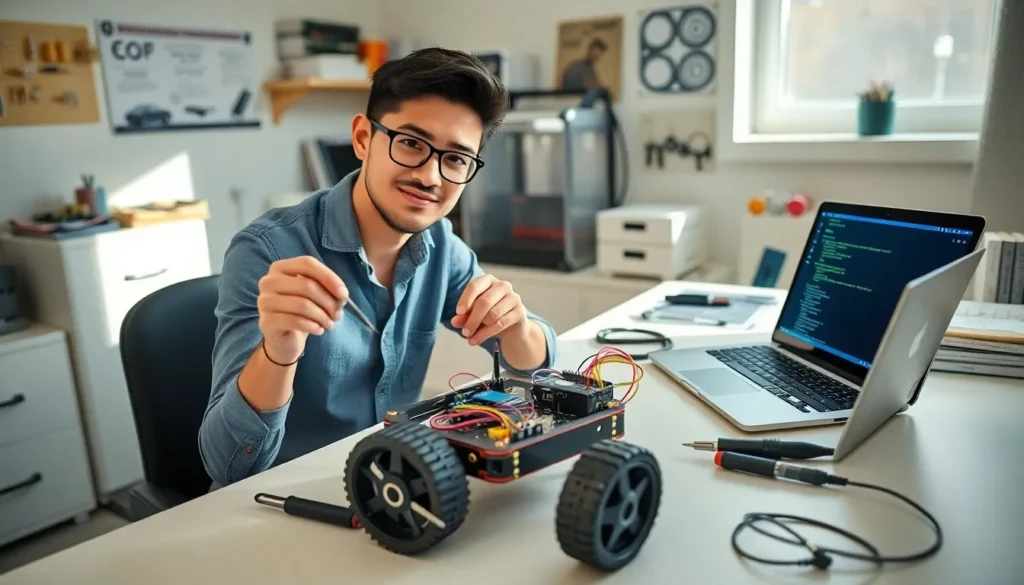

Learning how to robotics works doesn’t require an engineering degree or a basement full of expensive equipment. Anyone with curiosity and patience can build their first robot. The field has become more accessible than ever, with affordable kits, free online courses, and active communities ready to help newcomers.
This guide covers the essential steps for beginners who want to enter robotics. It explains core concepts, lists the skills worth developing, and points to practical resources. By the end, readers will have a clear path forward, no prior experience necessary.
Table of Contents
ToggleKey Takeaways
- Learning how to robotics works requires understanding three core disciplines: mechanics, electronics, and programming.
- Python is the most beginner-friendly programming language for robotics, offering clear syntax and extensive hardware libraries.
- Start with achievable projects like line-following robots or obstacle-avoiding bots to build foundational skills without frustration.
- Essential tools for beginners include Arduino or Raspberry Pi, sensor kits, motors, and basic hand tools like a soldering iron and multimeter.
- Free resources on platforms like Coursera, YouTube, and online communities such as Reddit’s r/robotics provide valuable support for newcomers.
- Simulation software like Gazebo and Webots helps test robot designs virtually before building physical prototypes.
Understanding the Basics of Robotics
Robotics combines three core disciplines: mechanics, electronics, and programming. A robot needs a physical body (mechanics), a way to sense and respond to its environment (electronics), and instructions that tell it what to do (programming). Understanding how these three elements work together forms the foundation of any robotics education.
Mechanics involves the robot’s structure, its frame, wheels, joints, and actuators. Beginners should learn basic concepts like torque, gear ratios, and center of gravity. These principles determine how a robot moves and interacts with objects.
Electronics covers sensors, motors, batteries, and microcontrollers. Sensors let robots detect light, distance, temperature, and more. Motors provide movement. Microcontrollers, like Arduino or Raspberry Pi, act as the brain, processing sensor data and sending commands to motors.
Programming brings everything together. Code tells the robot when to move, how fast to spin its wheels, or when to stop before hitting a wall. Most beginner-friendly platforms use Python, C++, or block-based languages like Scratch.
Robots can be autonomous (they make decisions on their own) or remote-controlled (a human operator directs them). Many beginners start with remote-controlled projects before advancing to autonomous systems. This progression builds confidence and practical skills without overwhelming learners early on.
Essential Skills You Need To Learn
Successful robotics enthusiasts develop a mix of technical and problem-solving abilities. Here are the key skills worth prioritizing:
Programming
Coding is non-negotiable. Python remains the most beginner-friendly language for robotics. It has clear syntax and extensive libraries for controlling hardware. C++ offers more speed and is common in professional robotics. Start with one language and become comfortable before branching out.
Basic Electronics
Understanding circuits helps troubleshoot problems and design better robots. Learn to read circuit diagrams, use a multimeter, and solder connections. Know the difference between analog and digital signals. These fundamentals prevent countless headaches during builds.
Mechanical Assembly
Robots require physical construction. Familiarity with hand tools, 3D printing, and CAD software proves valuable. Even simple tasks, cutting materials, drilling holes, securing components, demand practice.
Problem-Solving and Debugging
Robots rarely work perfectly on the first try. Something always goes wrong. A motor spins the wrong direction. A sensor gives bad readings. Effective roboticists approach these issues systematically. They isolate variables, test components individually, and document what works.
Math Fundamentals
Algebra, geometry, and basic trigonometry appear frequently in robotics calculations. Calculating distances, angles, and movement paths requires these skills. Advanced projects may involve linear algebra and calculus, but beginners can start with simpler math.
Choosing Your First Robotics Project
The right starter project teaches core concepts without causing frustration. Beginners should pick something achievable within a few weeks. Here are proven options:
Line-Following Robot: This classic project uses sensors to detect a dark line on a light surface. The robot follows the line automatically. It teaches sensor input, motor control, and basic programming logic. Kits are inexpensive and widely available.
Obstacle-Avoiding Robot: Similar to a line follower, but uses ultrasonic or infrared sensors to detect objects. The robot changes direction when it senses a wall or obstacle. This project introduces conditional programming and sensor calibration.
Robotic Arm: A small servo-powered arm teaches joint movement, angles, and coordinate systems. Some versions can pick up small objects. This project requires more patience but offers satisfying results.
Wheeled Remote-Control Bot: Building a simple RC car or tank helps beginners understand motor drivers, wireless communication, and basic chassis design. It’s fun and provides a foundation for later autonomous projects.
When selecting a first project, consider available budget and time. Starter kits from brands like Arduino, LEGO Mindstorms, or VEX include everything needed. They also come with instructions and community support, both valuable for newcomers learning how to robotics projects come together.
Tools and Resources for Learning Robotics
The right resources accelerate learning and prevent wasted effort. Here’s what beginners should gather:
Hardware
- Arduino Uno or Raspberry Pi: Both platforms work well for beginners. Arduino suits hardware-focused projects. Raspberry Pi handles more complex computing tasks.
- Sensor kits: Bundles with ultrasonic, infrared, and light sensors provide variety for experiments.
- Motors and drivers: DC motors, servo motors, and motor driver boards enable movement.
- Basic tools: Screwdrivers, wire strippers, soldering iron, and a multimeter cover most needs.
Online Courses and Tutorials
Free and paid courses exist on platforms like Coursera, Udemy, and YouTube. Look for courses that combine theory with hands-on projects. Channels like GreatScott., Andreas Spiess, and Paul McWhorter offer excellent robotics content.
Books
Robot Building for Beginners by David Cook remains a solid introduction. Programming Robots with ROS covers software for more advanced learners. Most libraries stock robotics books, making exploration affordable.
Communities
Online forums provide support when projects stall. Reddit’s r/robotics, Arduino forums, and Raspberry Pi communities answer questions quickly. Local maker spaces and robotics clubs offer hands-on help and equipment access.
Simulation Software
Tools like Gazebo and Webots let users test robot designs virtually. Simulation saves time and money by catching errors before building physical prototypes. Many schools and companies use these tools professionally.


